Written by Bryson Stephen, Attorney at Law
Asset Protection Planners has worked with Cook Islands asset protection structures since 1996, and our practice’s broader asset protection work dates to 1991. We work with licensed Cook Islands trustee companies and assist clients with trust formation, related LLC structures, funding, and ongoing administration.
The Cook Islands has been one of the world’s leading jurisdictions for offshore asset protection trusts since its International Trusts Act was strengthened in 1989. Unlike an ordinary U.S. trust, a properly structured Cook Islands trust places the trustee — and, depending on the structure, certain trust assets — outside the direct jurisdiction of U.S. courts, while subjecting the trust itself to Cook Islands law. Asset Protection Planners has worked with Cook Islands asset protection structures since 1996, and we’ve put together this guide covering what these trusts are, how they work, what they can and cannot do, and who should — and should not — consider one.
- What is a Cook Islands Trust?
- The History of Trusts
- Features and Benefits of Cook Islands Trusts
- How We Use Cook Islands Trusts to Protect Your Assets
- Who Should Consider a Cook Islands Trust?
- Who Should Not Consider a Cook Islands Trust?
- Common Uses of Cook Islands Trusts
- How to Set Up a Cook Islands Trust
- Cook Islands Trust Costs and Maintenance
- What Role Do Trustees Play in Cook Islands Trusts?
- Cook Islands Trust Court Cases and Legal Precedent
- What a Cook Islands Trust Cannot Do
- What to Keep in Mind When Creating a Cook Islands Trust
What is a Cook Islands Trust?
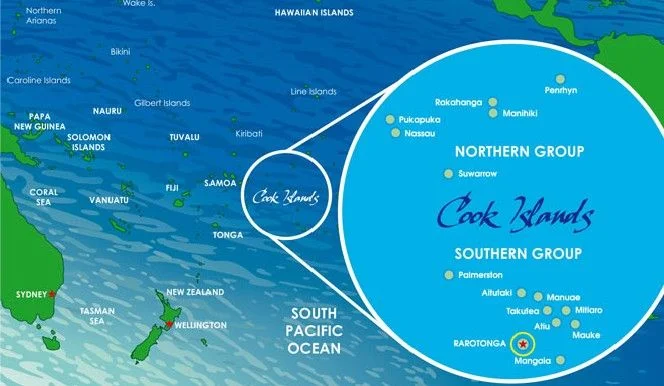
A Cook Islands Trust is a type of offshore asset protection trust established within the Cook Islands, a chain of 15 small islands located northeast of New Zealand. While these islands originally gained fame as a tropical vacation destination, they’re now better known as a home for some of the strongest statutory asset protection in the world.
More than 40 years ago, the Cook Islands passed the International Trusts Act of 1984, laying out the legal framework for offshore asset protection trust establishment and codifying the benefits Cook Islands Trusts are known for — asset protection, non-recognition of foreign judgments, and confidentiality.
In 1989, the Cook Islands legislature amended the International Trusts Act, primarily to strengthen its asset protection statutes. Among other things, the amendments allowed a settlor (the person who establishes the trust) to also be named a beneficiary — a departure from most jurisdictions at the time, which generally required a settlor to give up all beneficial interest in transferred assets. The Cook Islands’ statutes went on to influence similar legislation in jurisdictions such as Nevis and Belize.
The 1989 amendments allowed for trusts that protected assets in ways no other jurisdiction offered at the time. As the first jurisdiction to adopt these provisions, the Cook Islands has built a substantial body of case law over the decades, which itself reinforces the protection the trusts provide.
The Cook Islands Financial Supervisory Commission (FSC) is the government body responsible for licensing and supervising trustee companies and for maintaining the registry of international trusts, companies, and other entities formed under Cook Islands law.2 These trusts are not designed to hide assets from tax or reporting authorities. Instead, they are designed to help keep your assets safe — subject to their own compliance regime, with U.S. persons who establish one taking on separate IRS and FinCEN reporting obligations, discussed later in this guide.
The History of Trusts
The trust as a legal concept traces back to 1066, when William the Conqueror established the Common Law of England. Under early Common Law, individuals could transfer legal title to land to a person they trusted to manage it on their behalf — an idea that, centuries later, evolved into the modern trust.
For hundreds of years, trusts were used almost exclusively for domestic purposes, offering only limited asset protection. That began to change when the Isle of Man passed its Trustee Act of 1961, which clarified the powers, appointment, and discharge of trustees, and limited the extent to which local courts could reach trust-held assets. For a time, this made the Isle of Man a leading destination for offshore trust planning.
The Cook Islands built on that foundation. Working with U.S. attorneys, the Cook Islands legislature drafted the International Trusts Act 1984 — asset protection statutes that went further than the Isle of Man’s — and the jurisdiction has since become the most widely used destination for offshore asset protection trusts. Nevis has since adopted and adapted similar statutory provisions, making it a well-regarded jurisdiction in its own right.
Because trusts have existed for centuries, courts are broadly familiar with how they operate, and there is a deep body of case law addressing them. That said, “familiar” does not mean “unchallenged” — as discussed below, Cook Islands trusts have been tested in U.S. courts, and the outcomes of those cases matter as much as the underlying statute.
Features and Benefits of Cook Islands Trusts
A Cook Islands Trust provides substantial benefits for individuals seeking strong, statute-backed asset protection. To help you better understand the value Cook Islands Trusts provide relative to other structures, we’ve laid out their primary features and benefits below.
Basic Features of Cook Islands Trusts
| Cook Islands Trust | Details |
|---|---|
| General | |
| Type | Asset Protection Trust |
| Law | British Common Law |
| Statute | International Trusts Act (1984) and amendments |
| Time to Establish | Typically a few business days after your due diligence documents are received, assuming know-your-client documentation is provided promptly |
| Tax | No Cook Islands tax on the trust itself; you remain responsible for your own country’s tax obligations on trust income |
| Double Taxation Treaties | No |
| Monetary | |
| Currency | New Zealand Dollar (NZD) |
| Allowed Currencies | Any (including U.S. dollars and euros) |
| Cryptocurrencies Allowed | Yes |
| Parties and Privacy | |
| Minimum Number of Parties | One |
| Trust Deed | Not publicly recorded |
| Recognizes Foreign Judgments | Generally no — see below for nuance |
| Lifespan of Trust | Can be indefinite |
| Costs | |
| Setup Cost | Varies — please inquire |
| Annual Renewal | Varies — please inquire |
Benefits of a Cook Islands Trust
- A long, tested history of asset protection case law
- A self-governing nation in free association with New Zealand; Cook Islands citizens are also New Zealand citizens, and the jurisdiction is regarded internationally as politically stable1
- Generally does not recognize or enforce foreign court judgments against trust assets; a creditor typically must bring a new proceeding in the Cook Islands, subject to Cook Islands law and its procedural and evidentiary requirements
- For certain fraudulent-disposition challenges under the International Trusts Act, the creditor bears the unusually high burden of proving the required elements beyond a reasonable doubt — the criminal-law standard, not the civil “preponderance of the evidence” standard used in most U.S. courts3
- A one-to-two-year statute of limitations generally applies to fraudulent-disposition claims, after which a transfer generally cannot be challenged on that basis3
- Assets can be located anywhere in the world, and transfers into the trust can be made electronically
- One of the oldest and most tested offshore asset protection trust structures in the world
- Under Cook Islands law, a creditor generally must prove the settlor’s principal intent was to defraud that specific creditor — not creditors generally4
- Useful for estate planning and international diversification of holdings
- Trust deeds are not recorded in public records, providing significant confidentiality
- A wide range of investment options is generally available
- Trust assets are generally treated separately from a later personal bankruptcy of the settlor or beneficiaries, subject to the facts and applicable law
How We Use Cook Islands Trusts to Protect Your Assets
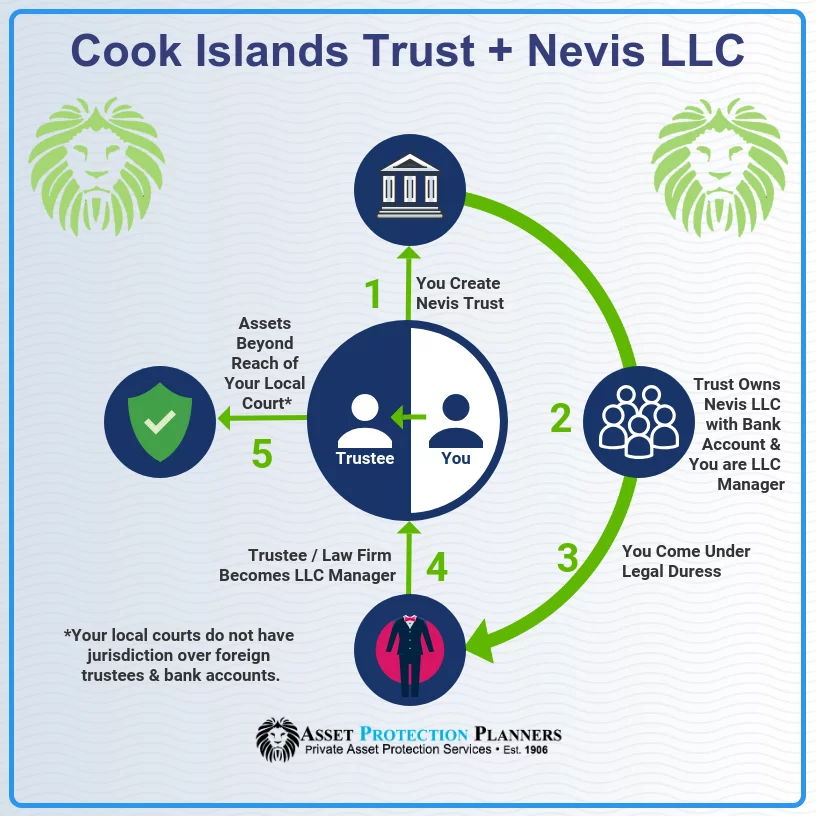
A properly established and maintained Cook Islands Trust can provide substantial asset protection advantages, although the result in any particular case depends on the facts, the timing of transfers, the assets involved, applicable law, and how the structure has been administered. We strengthen the basic trust structure by adding another layer of separation between you and the underlying assets. Our process generally involves:
- Setting up a limited liability company (LLC) with you as the manager
- Placing the LLC inside the trust
- Opening a bank account in the LLC’s name
- Depositing your assets into that LLC-owned account
Once this is complete, the trust owns the LLC. As the initial manager of the LLC and a signatory on its account, you retain day-to-day control while things are calm — moving funds, buying or selling assets, and working with the trustee to amend the trust’s terms as your situation changes.
If a U.S. court later enters a judgment against you, the licensed Cook Islands trustee company we work with can step in as manager of the LLC. A U.S. court does not have jurisdiction over that trustee company, so an order directed at the trustee generally has no legal force in the Cook Islands. This is a genuine and well-established feature of Cook Islands law — but it is not a license to disregard a court order directed at you personally.
It’s important to be precise here: a settlor remains obligated to comply with lawful court orders that apply to them. A Cook Islands trust does not give a settlor permission to ignore a judge, conceal assets that must be disclosed, or violate an existing court order or injunction. U.S. courts have used their contempt powers against settlors in offshore-trust cases where the court concluded the settlor retained effective control over the assets or had engineered their own inability to comply — see the case discussion below. The protective structure works precisely because it is administered properly and independently, not because it lets a settlor act in bad faith toward a court.
The purpose of establishing a Cook Islands Trust is not to conceal assets from the government — it’s to protect them from private creditors and civil litigants. Any personal or business taxes owed on income the assets generate remain your responsibility, making the structure tax-neutral, not tax-avoiding.

Who Should Consider a Cook Islands Trust?
Cook Islands Trusts are generally well suited for:
- High-net-worth individuals who want to protect accumulated wealth from future legal threats
- Business owners looking to safeguard business assets from potential lawsuits and creditors
- People in high-risk professions — physicians, attorneys, and others who face an elevated risk of being sued
- Estate planners seeking an orderly, tax-efficient transfer of wealth to future generations
Who Should Not Consider a Cook Islands Trust?
Cook Islands Trusts are not appropriate for everyone. It’s worth distinguishing between what the law prohibits, what a licensed Cook Islands trustee company will generally decline to accept as a matter of its own compliance policy, and what our firm’s client-acceptance policy requires:
- Tax evaders. Using a trust to evade taxes is illegal, and we do not accept clients who state that intent.
- Criminal defendants seeking to hide assets. Cook Islands trustee companies will not knowingly establish a trust intended to conceal assets during an active criminal case.
- People already facing a government civil enforcement action. Trustee companies and compliance personnel are generally unwilling to onboard a client who is actively trying to defeat an existing enforcement action by an agency such as the SEC or FTC. This is a compliance and risk-based practice among trustee companies and firms like ours, rather than a single, universal statutory prohibition — but as a practical matter, it will very likely prevent a trust from being established or funded in that circumstance.
- Those with limited assets. For people with less than roughly $250,000 in assets, more cost-effective domestic options are usually available, and we’re happy to discuss those.
Common Uses of Cook Islands Trusts
Beyond protecting against a specific lawsuit, Cook Islands Trusts are one of the most versatile tools within a broader asset protection trust strategy. Common uses include:
- Pre-divorce or pre-marital planning
- Leverage in negotiating a legal settlement
- Estate and legacy planning (a Cook Islands Trust can last indefinitely)
- Avoiding forced heirship rules, so you retain control over who inherits
- General wealth preservation and diversification
- Retirement planning
- Protecting intellectual property such as patents, copyrights, and trademarks
- Retaining real estate holdings
How to Set Up a Cook Islands Trust
- Consult with an experienced asset protection firm. Asset Protection Planners has attorneys and consultants on staff who can walk through your goals and whether this structure fits your situation.
- Identify the key parties. Every Cook Islands Trust involves: – Settlor — the person establishing the trust (you) – Trustee — the licensed Cook Islands trustee company responsible for managing the trust – Beneficiaries — those who benefit from the trust – Protector (optional) — a person or entity, outside your local court’s jurisdiction, with oversight powers over the trustee
- Draft the trust deed. Attorneys at our firm draft the trust deed, which sets out the terms, conditions, and roles of the settlor, trustee, protector, and beneficiaries.
- Complete the required documentation, generally including: – A certified copy of your passport or driver’s license – Proof of address (a utility bill or bank statement) – Evidence of funds (a bank reference letter) – A solvency affidavit or certificate – A signed Money Laundering Control Act declaration – A deed of indemnity protecting the trustee for acts taken in good faith
- Transfer assets into the trust. Once transferred, the assets are legally owned by the trust and subject to its protective structure.
Looking for a more detailed walk-through? See our guide on how to establish a Cook Islands Trust.
Cook Island Trust Costs and Maintenance
Setting up and maintaining a Cook Islands Trust involves several categories of cost:
- Setup costs: Varies — please inquire, as we do not publish fixed pricing given the range of structures we design for clients and other attorneys
- Annual maintenance fees: Generally in the $5,000–$10,000 range
- Additional entities: An LLC placed inside the trust, or real estate holding structures, add to the cost
- Additional costs: Compliance reporting, tax preparation, and trustee fees
While Cook Islands Trust costs may seem significant, they’re usually far smaller than the cost of losing assets in a lawsuit. For context, industry-wide setup costs for comparable structures often range from roughly $35,000 to $60,000; our pricing is generally lower than that range, though the exact cost depends on your specific structure.
Ongoing maintenance includes annual fees, monitoring for compliance with Cook Islands and U.S. requirements, periodic review of how the trust is being administered, and updates to trust documents as your circumstances change. We provide a registered office and help remind clients of annual renewal filings.
What Role Do Trustees Play in Cook Islands Trusts?
The trustee’s role is to manage and protect the LLC and assets held within the trust according to the trust deed. If a court enters a judgment against you that could threaten those assets, the licensed Cook Islands trustee company can step in as manager of the LLC.
If you personally remained in control of the LLC and were ordered by a court to turn over the assets, you would be legally obligated to comply — the same is true of a settlor of a domestic trust, which is one reason domestic asset protection trusts (in states like Nevada, Wyoming, or Delaware) generally offer weaker protection than an offshore structure. With a Cook Islands trust, once the trustee has taken over management, that trustee company is not subject to your home court’s jurisdiction, and a repatriation order directed at the trustee generally cannot be enforced against it.

Impossibility to Act
In some offshore-trust cases, courts have considered whether a settlor genuinely lacks the legal ability to compel a foreign trustee to return trust assets — sometimes called an “impossibility” defense. Whether that defense succeeds is fact-dependent. Courts have looked closely at the settlor’s retained powers, the timing of the transfer relative to the claim giving rise to the judgment, and the circumstances under which control shifted to the trustee. It is not something a trust automatically creates; it depends on how the structure was built and administered, and on the settlor’s own conduct throughout. This is exactly why proper drafting, appropriate timing, genuine trustee independence, and correct administration matter — and why we discourage clients from setting up a structure only after a claim has already arisen or become foreseeable.

The Trustee Is Regulated, Not Unaccountable
We understand it can feel uncomfortable to place significant assets under the management of a trustee you don’t personally know. Trustee companies in the Cook Islands are licensed and supervised by the FSC, which imposes fit-and-proper-person standards, capitalization requirements, and mandatory professional indemnity insurance, and operating as a trustee company without a license is a criminal offense under Cook Islands law.5 We do not represent that this licensing and insurance framework guarantees you will be made whole in every circumstance — but it does mean trustee companies operate under real regulatory oversight, not informally.
Our firm has worked with licensed Cook Islands trustee companies for nearly three decades, and we vet those relationships on an ongoing basis.
If courts prevent you from directly accessing trust assets, the trust can typically be drafted in advance to allow the trustee to cover certain living, business, or legal expenses on your behalf from trust funds — a contingency we build into our structures from the outset.
Cook Islands Trust Court Cases and Legal Precedent
A Cook Islands trust is powerful, but it has been tested in real litigation — and understanding those cases matters more than reciting the statute alone.
The best-known example is FTC v. Affordable Media, LLC, 179 F.3d 1228 (9th Cir. 1999), often referred to by the settlors’ surname as the Anderson case. The FTC pursued the Andersons over an underlying telemarketing scheme and sought to reach assets they had placed in a Cook Islands trust. The Ninth Circuit affirmed a civil contempt order against the Andersons for failing to repatriate the trust assets, finding they had not met their burden of showing compliance was genuinely impossible — largely because the court concluded they retained practical control over the trust through their own roles as co-trustees and trust protectors. The case is frequently misread as proof that Cook Islands trusts “don’t work.” A fuller reading cuts both ways: the Cook Islands High Court separately upheld the validity of the trust itself and awarded costs against the FTC, and the trust assets were never actually turned over to the U.S. court. What the case demonstrates is not that the jurisdiction failed, but that a settlor’s own conduct — serving as co-trustee, retaining hands-on control — can undercut the very independence the structure depends on.
The lesson from that case, and others like it, is straightforward: a Cook Islands trust does not give a settlor permission to ignore a U.S. court. What it does is place the trustee and trust assets outside a U.S. court’s direct jurisdiction, provided the structure is genuinely independent and properly administered. Timing, drafting, trustee independence, and how the settlor conducts themselves before and after a claim arises are what determine whether that protection functions as intended.

What a Cook Islands Trust Cannot Do
To be direct about limitations, a Cook Islands Trust:
Does not eliminate your IRS foreign-trust reporting obligations (including Form 3520/3520-A where applicable) or FinCEN FBAR reporting where applicable
Cannot lawfully be used to conceal assets that must be disclosed in litigation, bankruptcy, or to a regulator
Cannot eliminate your U.S. tax obligations on income the trust assets generate
Cannot undo a transfer already found to be a fraudulent transfer under applicable law
Cannot guarantee a particular outcome in litigation
Cannot prevent a U.S. court from exercising its authority over you personally, as opposed to over the foreign trustee
Cannot be used to violate an existing court order or injunction
What to Keep in Mind When Creating a Cook Islands Trust
The most significant practical consideration is that you will be working with a foreign trustee you likely haven’t met before. That relationship is governed by real regulatory oversight, as discussed above, but it’s a meaningful step and deserves to be treated as one.
If you are a U.S. person, establishing the trust also triggers ongoing IRS and FinCEN reporting obligations, which must be satisfied every year; failing to do so can carry civil or criminal penalties. Working with a firm that regularly handles these structures — and that can help coordinate with your CPA on the reporting side — meaningfully reduces that burden.
Weighed against the risk of leaving significant assets exposed to a future lawsuit, most clients find that risk manageable, particularly when the structure is set up correctly and administered on an ongoing basis.
Set Up a Cook Islands Trust with Help from Asset Protection Planners
When properly structured, a Cook Islands Trust can meaningfully strengthen your position against future lawsuits and creditors while supporting your broader estate planning goals.
If you work in a field with elevated litigation exposure — medicine or law, for example — hold substantial assets, or simply want to plan ahead of a potential future claim, contact us to discuss whether a Cook Islands Trust fits your situation.
Contact us today by filling out the form below to start the process.
Related Articles
About the Author
This article was written by Bryson Stephen, Attorney at Law. While every effort has been made to ensure accuracy, no guarantee is made that this content is complete or error-free, and laws are subject to change. This content is for informational purposes only, does not constitute legal advice, and does not create an attorney-client relationship. For guidance specific to your situation, consult with a licensed attorney.
- The Cook Islands is self-governed in free association with New Zealand. Cook Islanders also hold New Zealand citizenship. ↩
- Cook Islands Financial Supervisory Commission, Registry of International Trusts, Companies, and LLCs. ↩
- International Trusts Act 1984 (Cook Is.), as amended, § 13B. ↩↩
- International Trusts Act 1984 (Cook Is.), as amended, § 13B. ↩
- Trustee Companies Act 2014 (Cook Is.); Cook Islands Financial Supervisory Commission trustee licensing requirements. ↩